Can you legally buy kratom where you live? For most people in the United States the answer is yes, but “most” is doing real work in that sentence, and the map has changed more than once in the past few years.
Here is where things stand as of July 2026, along with what to watch for locally. Let’s jump in!
Is Kratom Legal Federally?
Yes. Kratom is not a controlled substance under federal law, and it is legal to buy, sell and possess in the United States at the federal level.
The DEA moved to schedule kratom back in 2016 and withdrew the proposal after substantial public and congressional pushback. It has remained on the agency’s “drugs of concern” list since, which sounds alarming but carries no legal force. The FDA has separately taken the position that kratom is not approved for any medical use, which is why every reputable vendor sells it without health claims attached.
Worth being clear on one point, because the framing causes confusion: kratom is a tropical botanical in the coffee family, not an opiate. It also does not appear on a standard 5-panel drug test, something we cover properly in our guide to kratom and drug testing.
(Affiliate link — we may earn a commission.)
States Where Kratom Is Banned
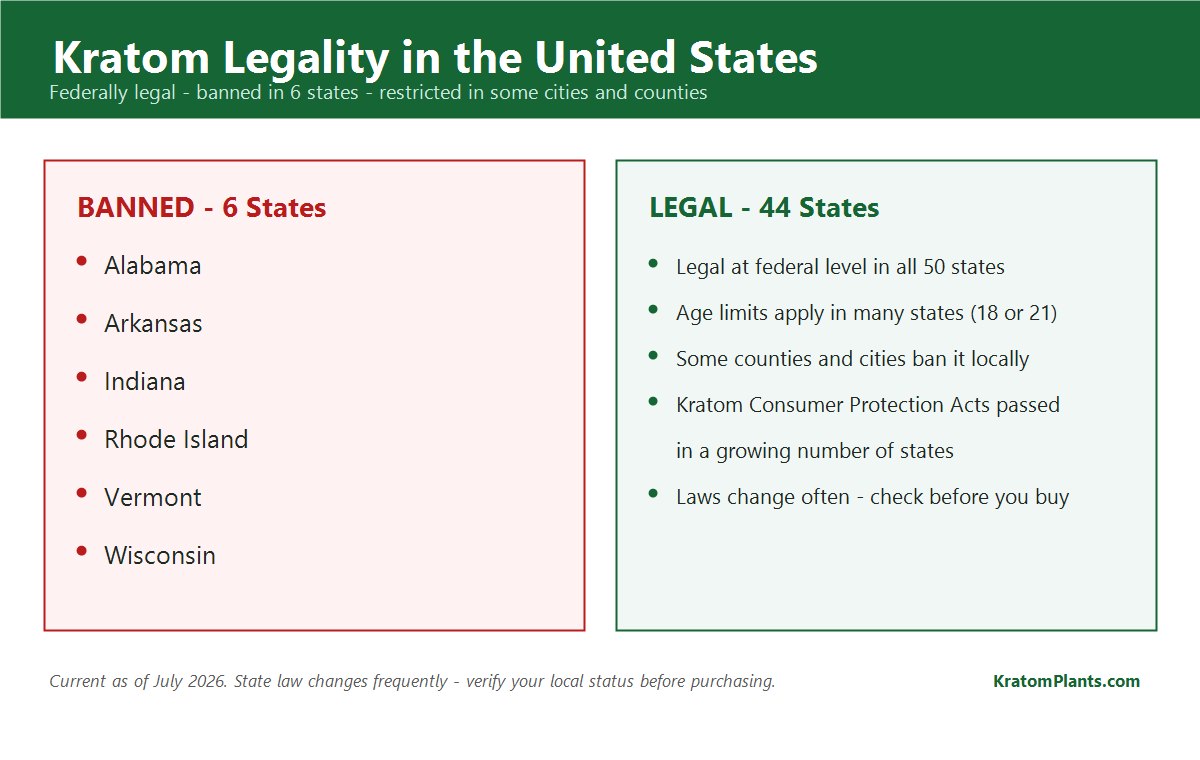
Six states prohibit kratom outright. Possession, sale and purchase are all illegal in these places, and vendors will not ship there.
| State | Status | Notes |
|---|---|---|
| Alabama | Banned | Alkaloids listed as controlled substances |
| Arkansas | Banned | Controlled substance since 2016 |
| Indiana | Banned | Classified as a synthetic drug, long-standing ban |
| Rhode Island | Banned | Repeal efforts have been raised repeatedly |
| Vermont | Banned | Alkaloids on the regulated drug list |
| Wisconsin | Banned | Schedule I since 2014 |
If you live in one of these six, ordering online does not create a loophole. Reputable vendors block shipping to banned states, and the ones that do not are exactly the vendors you should avoid on every other measure too.
Where Kratom Is Legal With Conditions
Legal does not always mean unrestricted. Several states permit kratom but attach rules, most commonly a minimum age and labelling requirements.
- Age limits. Many states set a floor of 18, and some have moved to 21. Expect ID checks at physical retailers and age gates online.
- Kratom Consumer Protection Acts. A growing number of states have passed versions of this legislation, which requires accurate labelling, bans adulterated products, and sets purity standards. This is consumer-friendly regulation rather than restriction.
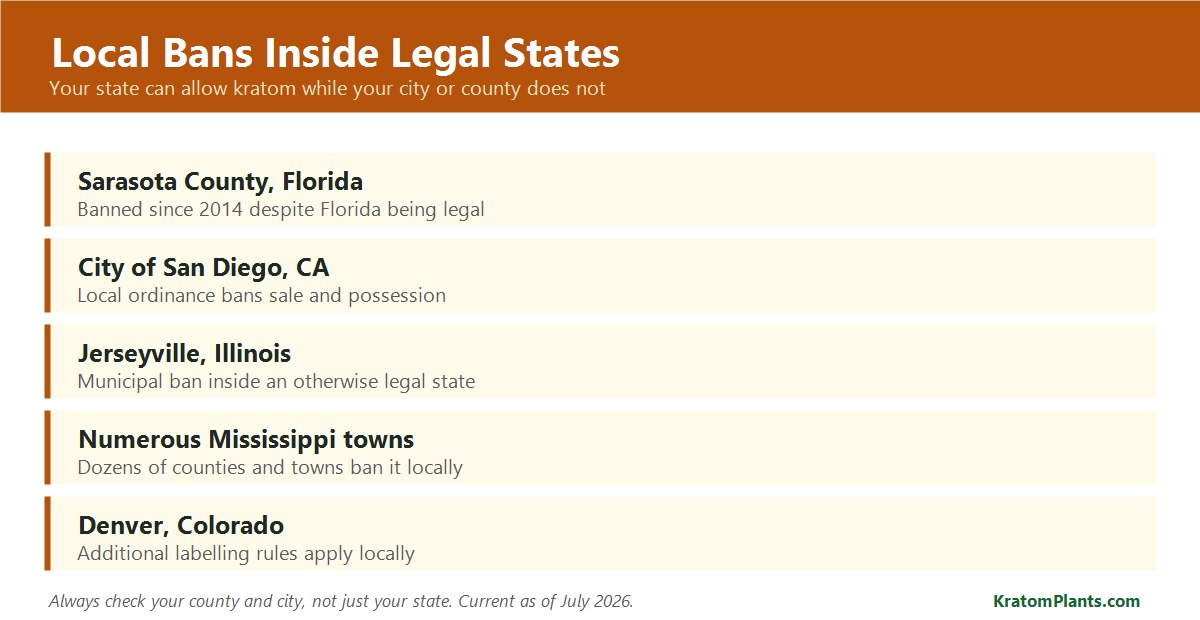
- Local bans inside legal states. This is the one that catches people out. San Diego, Sarasota County in Florida, and several municipalities in Mississippi and Illinois have their own prohibitions even though the surrounding state permits kratom.
Illinois is the clearest example of the age rule in action. Kratom is legal statewide for adults but banned for anyone under 18, and the city of Jerseyville has prohibited it entirely.
The States People Ask About Most
These come up constantly, so here is the direct answer for each.
| State | Legal? | What to know |
|---|---|---|
| Florida | Yes | Legal statewide except Sarasota County, which bans it. Age limit applies. |
| Texas | Yes | Legal with no statewide restrictions beyond age. |
| California | Yes | Legal statewide except the City of San Diego. |
| Michigan | Yes | Legal. Scheduling attempts have been raised and not passed. |
| Georgia | Yes | Legal with a Consumer Protection Act and a 21 age limit. |
| Ohio | Yes | Legal. A pharmacy board scheduling proposal did not take effect. |
| Tennessee | Yes | Legal for those 21 and over. Plain leaf only. |
| Illinois | Yes | Legal for adults. Jerseyville bans it locally. |
| Mississippi | Mostly | Legal statewide but banned in a significant number of counties and towns. |
| Colorado | Yes | Legal, with local rules in Denver around labelling. |
Mississippi deserves a specific warning. The statewide position is permissive, but dozens of individual counties and municipalities have passed their own bans, so the practical answer genuinely depends on your town rather than your state.
Full State-by-State Status
Every state, in one table. “Legal” here means no statewide prohibition, though local bans and age limits may still apply.
| State | Status | State | Status |
|---|---|---|---|
| Alabama | Banned | Montana | Legal |
| Alaska | Legal | Nebraska | Legal |
| Arizona | Legal (KCPA) | Nevada | Legal (KCPA) |
| Arkansas | Banned | New Hampshire | Legal (18+) |
| California | Legal, not San Diego | New Jersey | Legal |
| Colorado | Legal | New Mexico | Legal |
| Connecticut | Legal | New York | Legal (21+) |
| Delaware | Legal | North Carolina | Legal (18+) |
| Florida | Legal, not Sarasota Co. | North Dakota | Legal |
| Georgia | Legal (KCPA, 21+) | Ohio | Legal |
| Hawaii | Legal | Oklahoma | Legal (KCPA) |
| Idaho | Legal | Oregon | Legal (KCPA) |
| Illinois | Legal 18+, not Jerseyville | Pennsylvania | Legal |
| Indiana | Banned | Rhode Island | Banned |
| Iowa | Legal | South Carolina | Legal |
| Kansas | Legal | South Dakota | Legal |
| Kentucky | Legal | Tennessee | Legal (21+, leaf only) |
| Louisiana | Legal | Texas | Legal |
| Maine | Legal | Utah | Legal (KCPA) |
| Maryland | Legal | Vermont | Banned |
| Massachusetts | Legal | Virginia | Legal |
| Michigan | Legal | Washington | Legal |
| Minnesota | Legal (18+) | West Virginia | Legal |
| Mississippi | Legal, many local bans | Wisconsin | Banned |
| Missouri | Legal | Wyoming | Legal |
KCPA indicates the state has adopted a version of the Kratom Consumer Protection Act. Age limits shown where a specific statewide minimum applies.
Why the Rules Keep Changing
Kratom legislation moves in two opposite directions at once, which is why any guide including this one carries an expiry date.
On one side, prohibition bills appear in state legislatures most sessions, usually following media coverage of an adverse event. On the other, the Kratom Consumer Protection Act model has been gaining ground steadily, and it does the opposite of banning: it legitimises kratom while setting quality standards that push adulterated products off shelves.
The pattern over the past decade has actually favoured legality. Several states that banned kratom have since revisited it, and the Consumer Protection Act model has spread further than the prohibition model. Legislators who look closely at kratom tend to conclude that regulating product quality solves more problems than a ban does, partly because bans push buyers toward unregulated sellers rather than removing demand.
What has changed the conversation most recently is concentrated 7-OH products. These are a very different thing from plain leaf, and several states now write laws that distinguish between the two, permitting leaf while restricting isolated or enhanced alkaloid products. Tennessee’s leaf-only rule is the clearest example. Expect more states to draw that line, which is good news for anyone buying ordinary powder and worth watching if you use extracts.
The practical upshot for you is simple. Check before you buy, especially if you have moved, and check again if you have not bought in a year. The American Kratom Association maintains the most current tracking of pending legislation, and their GMP programme is also the most reliable signal of vendor quality, which we explain in our guide to AKA GMP qualified vendor status.
What Happens If You Get It Wrong
Nobody enjoys this part of the conversation, but knowing the actual stakes beats guessing at them.
In the six banned states, the penalties come from how each state classified kratom rather than from any kratom-specific law. Where the alkaloids sit on a controlled substances schedule, possession is treated like possession of any other scheduled substance in that state, which can mean a misdemeanour for small amounts and something more serious for quantities that look like distribution. Indiana and Wisconsin have the longest-standing bans and the clearest enforcement history.
In practice, the situations that catch people out are mundane rather than dramatic:
- Driving through a banned state. A traffic stop in Indiana with powder in the door pocket is the classic example. Federal legality is no defence against state law.
- Ordering to a work address in a different county. Local bans follow the delivery address, not your home address.
- Moving house. People rarely re-check the law when they relocate, and the six banned states include destinations people move to for work.
- Flying. TSA is not looking for kratom, but arriving in a banned state with it in your bag puts you under that state’s law on landing.
None of this is a reason for anxiety if you live in one of the 44 legal states. It is a reason to spend two minutes checking before you order, and to check again if anything about your circumstances has changed.

Buying Legally: What to Actually Do
- Confirm your state first. If you are in one of the six banned states, stop there.
- Then check your city and county. This is the step almost everyone skips, and it is where the surprises live.
- Buy from vendors who enforce the rules. A vendor willing to ship into Alabama is telling you something about how they handle everything else.
- Look for AKA GMP participation and published lab results. Both are voluntary, which is precisely why they signal something.
- Keep it in the original labelled packaging. Sensible if you travel between states.
Travelling with kratom across state lines into a banned state is where people get caught out. Federal legality does not override a state prohibition, and driving from a legal state into Indiana with powder in the car puts you on the wrong side of Indiana law. If you are looking for local options while travelling, our guide to finding kratom for sale near you covers what to look for in physical shops. For choosing what to actually buy once you have confirmed you can, our kratom strains chart compares every strain side by side, and our best kratom vendors list covers who we trust.
A Vendor That Follows the Rules
Kats Botanicals blocks shipping to banned states, publishes per-batch lab results, and participates in the AKA GMP programme. That combination is the practical shortlist when legality matters to you.
FTC Disclosure: We may earn a commission from purchases made through this link, at no extra cost to you.
How to Check Your Local Law in Five Minutes
State-level information is easy to find. County and city rules are where people give up, so here is the shortest reliable route.
- Start with the AKA legislative tracker. It lists current state status and any pending bills, and it is updated far more often than most blog posts on the subject, including this one.
- Search your county name plus “kratom ordinance”. Local bans are passed as ordinances, and that phrasing surfaces the actual council document rather than news coverage of it.
- Check whether a vendor will ship to your postcode. This is the fastest practical test. Add an item to a basket and enter your address. Compliant vendors maintain blocked-postcode lists and will tell you at checkout.
- Ask a local smoke shop or wellness retailer. If several sell it openly in your town, the local position is usually settled. If none do in an otherwise legal state, that absence is worth investigating.
Do this again if you move, and once a year otherwise. Bills appear most legislative sessions and a handful pass.
What about outside the US?
Different picture entirely, and stricter in most places. Kratom is banned or heavily restricted across much of Europe, including Denmark, Finland, Latvia, Lithuania, Poland, Romania and Sweden, and it is prohibited in Australia, Israel, Japan, Malaysia, Myanmar, South Korea and Thailand for consumer use. The United Kingdom banned it under the Psychoactive Substances Act in 2016.
Canada occupies a middle position where it can be sold but not marketed for human consumption, which is why Canadian listings describe it as incense or soap-making material. If you are outside the United States, verify locally before ordering anything, because customs seizure is the common outcome rather than a doorstep delivery.
Kratom Legality FAQ
Is kratom legal in the United States?
Yes at the federal level, and in 44 states. Six states ban it: Alabama, Arkansas, Indiana, Rhode Island, Vermont and Wisconsin. Some cities and counties inside otherwise legal states have their own bans.
What states is kratom illegal in?
Alabama, Arkansas, Indiana, Rhode Island, Vermont and Wisconsin prohibit it outright. Sarasota County in Florida, the City of San Diego, Jerseyville in Illinois and numerous Mississippi counties also ban it locally.
Is kratom legal in Florida?
Yes, everywhere in Florida except Sarasota County, which has banned it since 2014. An age restriction applies statewide, so expect to show ID.
Is kratom legal in Texas?
Yes. Texas has no statewide prohibition and no local bans of note, which makes it one of the more straightforward states. Age restrictions still apply at retail.
Can I order kratom online to a banned state?
No, and you should not try. Reputable vendors block shipping to the six banned states, and possession remains illegal regardless of where you bought it. A vendor that ships anyway is signalling how little they follow any other rule.
Is kratom a controlled substance?
Not federally. The DEA proposed scheduling it in 2016 and withdrew after public opposition, and it currently sits on the agency’s drugs of concern list, which carries no legal weight. Individual states have scheduled it themselves.
What is the Kratom Consumer Protection Act?
Model legislation adopted by a growing number of states that keeps kratom legal while setting standards for it. It requires accurate labelling, bans adulterated and synthetic products, and usually sets a minimum purchase age.
How old do you have to be to buy kratom?
It depends on the state. Many set the floor at 18, while others including Georgia and Tennessee require 21. Online vendors apply age verification regardless.
Legal Disclaimer & FDA Disclosure
Kratom (Mitragyna Speciosa) is a botanical supplement. The statements on this page have not been evaluated by the Food and Drug Administration. This content is for educational purposes only and is not intended to diagnose, treat, cure, or prevent any disease or medical condition.
This page is not legal advice. Kratom law changes frequently at state, county and city level. Always verify the current status where you live before purchasing or possessing kratom. If you are pregnant, nursing, taking prescription medications, or have a medical condition, consult a licensed healthcare provider before use.
KratomPlants.com does not sell kratom products. Some links on this page are affiliate links — we may earn a commission if you make a purchase, at no additional cost to you.